Saturday, January 21, 2023

Ponniyin Selvan in the light of History: Some Highlights

A look at the world of politics, statecraft, diplomacy and books

Ponniyin Selvan, the literary extravaganza created by Kalki still remains, nearly seven decades after is initial publication, one of the most popular novels of contemporary Tamil Nadu. Rightly so. Well written, with a tight narrative, revolving around the intrigues of succession in the Chola court, against the background of the Chola invasion of Sri Lanka, this novel fulfils all the criteria of a Historical Novel enumerated by George Lukcas. The setting of the plot is reasonably accurate, the characters are plausible in that they are situated in the glare of History, and there is no overt "fictionalizing" or the introduction of extra historical details. Like we cannot tae Sir Walter Scot's Waverly Novels as a record of medieval history, we cannot assume that Kalki has got his facts or perspective right. And that was not his goal.

The chronological framework of the Novel (PS) was derived from   Nilakanta Sastri's magnum opus, The Cholas which was published by the Madras University. The role of the Palluvettaraiyars, the clan to which Nandhini belonged was loyal to the Cholas right to the bitter end when Jatavarman Kulasekara Pandya triumphed over the Cholas in the thirteenth century and therefore the huge question mark over the loyalty of this Clan is not backed by evidence, though the twist does impart a dramatic dimension to the plot. The death of Rajaditya in the Battle of Takkolam in 949 AD is attested to by historical records like the Tiruvanladu Copper Plates and it also records the "disappearance" of Aditya, a subtle euphemism for the assassination, as shown in PS. The removal of Aditya the son of Sundara Chola Parantaka II (956-923) paved the way for Arulmorrivarman to ascend the throne as Rajaraja I (985-1014). A silence in the historical record is transmuted into an eloquent conspiracy, and this indeed, may have been so, but the records are silent. 


The Big Temple at Tanjavur has been studied by this Historian in the M S Najaraja Felicitation Volume and in the K V Ramesh Memorial Volume and so I will not go over those details here. However there are two curious details from the cinematic depiction of PS that are important.  These pertain to the use of the Horse as a fighting platform and the state of Naval Technology in Chola Tamil Nadu. Of course, Kalki has used his imagination and we are not faulting him for that. We are merely testing the cinematic depiction against contemporary records,
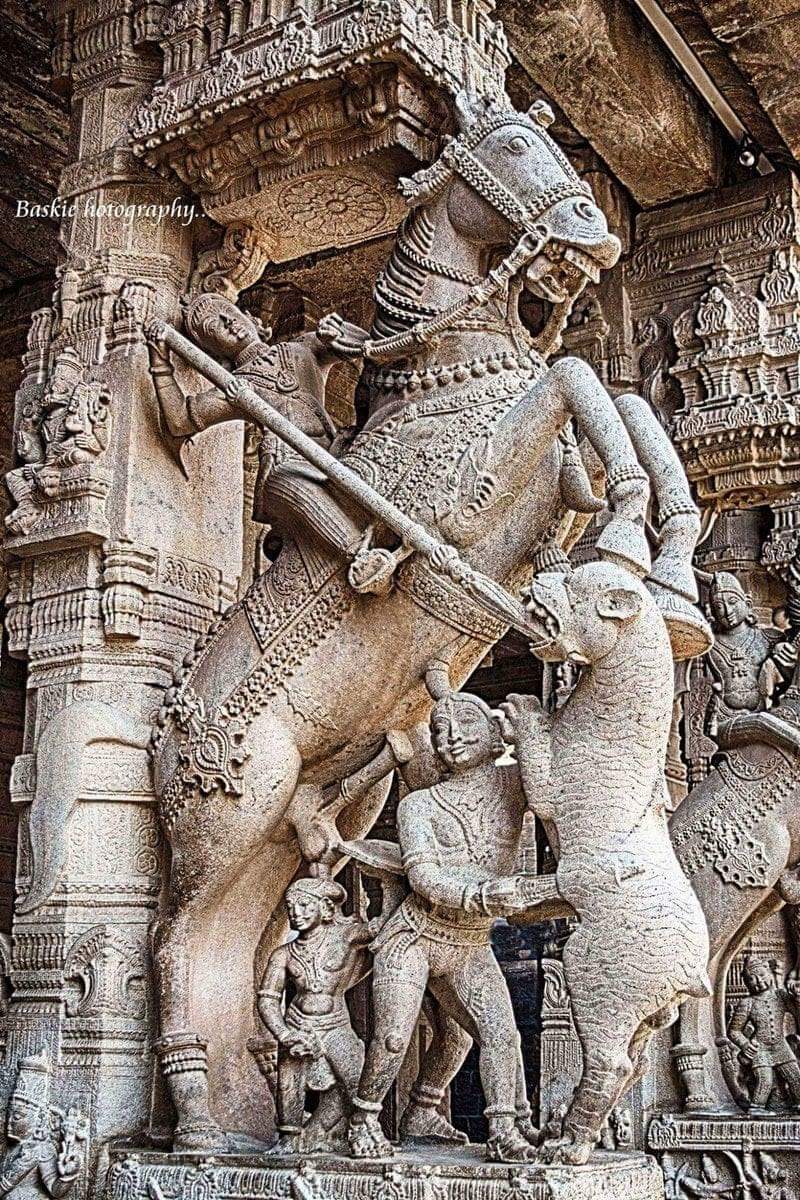

The figure on the left is from the Mandapa od the Srirngam Ranganatha Swami Temple. This sculpture depicts a horseman and belongs to the 15th century, after the temple had been rebuilt and reconsecrated by the Vijayanagara Rayas. What is to be noticed here is the absence of the stirrup, that vital innovation that is a force multiplier, the speed and weight of the horse to hurl the mounted soldier against his adversary. It is the stirrup that enables the rider to stay bolt upright and balance himself on the horse. The stirrup was unknown in South India until the advent of the Muslim Conquest in the fourteenth century. The battle scenes shown in the film PS show horses with saddles to which are attached stirrups, and as such anachronisms, in the bright glare of History.

The ships and water crafts shown in PS celebrate visual design not historical accuracy. Only one solitary example of a 13th century Indian Ship has been found so far and that too in distant Kerala. The Lateen sail shown on ships plying between Chola Ports and Sri Lanka were introduced only in the 13th century, and the Arabs were probably responsible for this technological advance. B Arunachalam in his Chola Navigation Package has illustrated Chola sea crafts of the time of Rajaraja I.
The Chola vessels were certainly sea worthy and the claim of Rajendra I that he conquered lands across the "rolling seas" is certainly true as they are attested by inscriptions found in the Gankaionda Chola Puram Temple. However, the shape and design and technical details are still unknown. And the reason is due to the heavy dose of identity politics and fanciful theories that dominate the field.

Monday, December 19, 2022

In the Forest of No Joy: The Congo=Ocean Railway and the Tragedy of French Colonialism ( A Review)

A look at the world of politics, statecraft, diplomacy and books 
 
Forest of No Joy
  Forest of No Joy: The Congo Ocean Railway      and the Tragedy of French Colonialism
   J P Daughton
   W W Norton and Company
    New York 2021.
   
   This book has been shortlisted for the               Cundill      Prize in History and it will not         surprise me if      it wins the Prize. Post             Colonialism in contemporary       historical       scholarship   privileges a set of themes which reinforce the  dominant ideological themes in western  society: political correctness, black lives matter, and a belief in race equity. In this book we have all three in good measure. 

Post colonialism has essentially hitched its wagon to the dominant ideological discourse emanating from western media and academia. Race Equity, identity politics and racial justice. Obviously the enormous human cost involved in the construction of this railway makes it an attractive proposition for such investigation that can stir the liberal western/white "Conscience" while skirting all important political and economic issues. For example, Racism can be critiqued as the institution animating western dominance over Africa and indeed other parts of the world. But the diplomatic and political contexts are to be studiously avoided. The defeat of France at the hands of Germany in the Franco-Prussian War of 1871 provided the immediate spur to colonialism in Africa and Germany encouraged this by essentially allowing France a free pass, wink-and-nod at the leap across the Mediterranean on the part of the Chancellor Bismarck. The entire edifice of western domination was built on racial ordering of the human race and the ideology of Progress made colonial societies inured to the costs they imposed on societies they ruled. In the case of the Congo-Ocean Railway too, we find the same allure of Progress an philosophical conceit that virtually dehumanises non white peoples and cultures. The author recognises this aspect when he states that European history recorded its achievements not the trauma of indigenous societies. Since the recognition of the Holocaust as a fact of History, Historians have adopted the eschatology of bearing witness and we find this element in the present book.

The route
   The French acquired the Congo       after the Congress of Berlin             when Belgium was given a part       of the same region. While the           horrors of Belgian Congo are           well documented, little is known     about French Congo. Before the       advent of the French, Dahomey,       the most powerful state in                 Central   Africa was the backbone of the Atlantic Slave Trade supplying slaves to both the Arab and European Slavers. This important fact is not even mentioned in this book, a bow towards political correctness. 

A cartoon lampooning the Railway 
   The Congo-Ocean Railway linked Brazzaville to Pointe-Noire on the Atlantic coast, very close to the notorious Slave Coast of Atlantic Africa. In terms of todays costs the entire 512 km railway cost around 2 billion US dollars and in terms of lives lost, around 17,000 men women and children as Child labour was not discouraged. Till this day the Congo-Ocean Railway is still the only railway track in the region.

The author documents in extreme detail the miserable conditions in which the workers toiled.  Since the region was forested and thinly populated, the colonial administration guaranteed the construction company, Bartignolles, the labour force it needed and this proved to be the original sin. Workers had to be "recruited" from Chad nearly 1500 kilometers to the north and all sorts of methods were employed. Chiefs were required to supply a quota of men and if they did not comply they were subjected to beatings in front of their villagers. Further able bodied men were kidnapped and taken in rows bound by coffle to the neck in the same humiliating fashion of slaves and any resistance was met with brute force. Men were shot and beaten to death and no questions were asked. Andre Gide who visited the region when Pacha was the Administrator wrote about the cruelties inflicted upon the people of the region. The Deputies, particularly the Socialists, raised questions in the Assembly and soon the furore died down. The living conditions of the workers was horrible and there was hardly any medical assistance at hand. Even the International Labour Organization did little more than ask a few perfunctory questions.

This book makes sad reading and even if we do not doubt the humanitarian spirit of the Historian, the larger question is: What are we do when confronted with such immense moral issues. Societies that have profited from such exploitation must give a percentage of their GDP as reparations to the affected region. This is the need of the hour. Not pious thernodies.